Understand what robots are; Understand basic robot building skills; Develop an interest in scientific exploration;
Grade 1 - Grade 2 (ages 6–7)
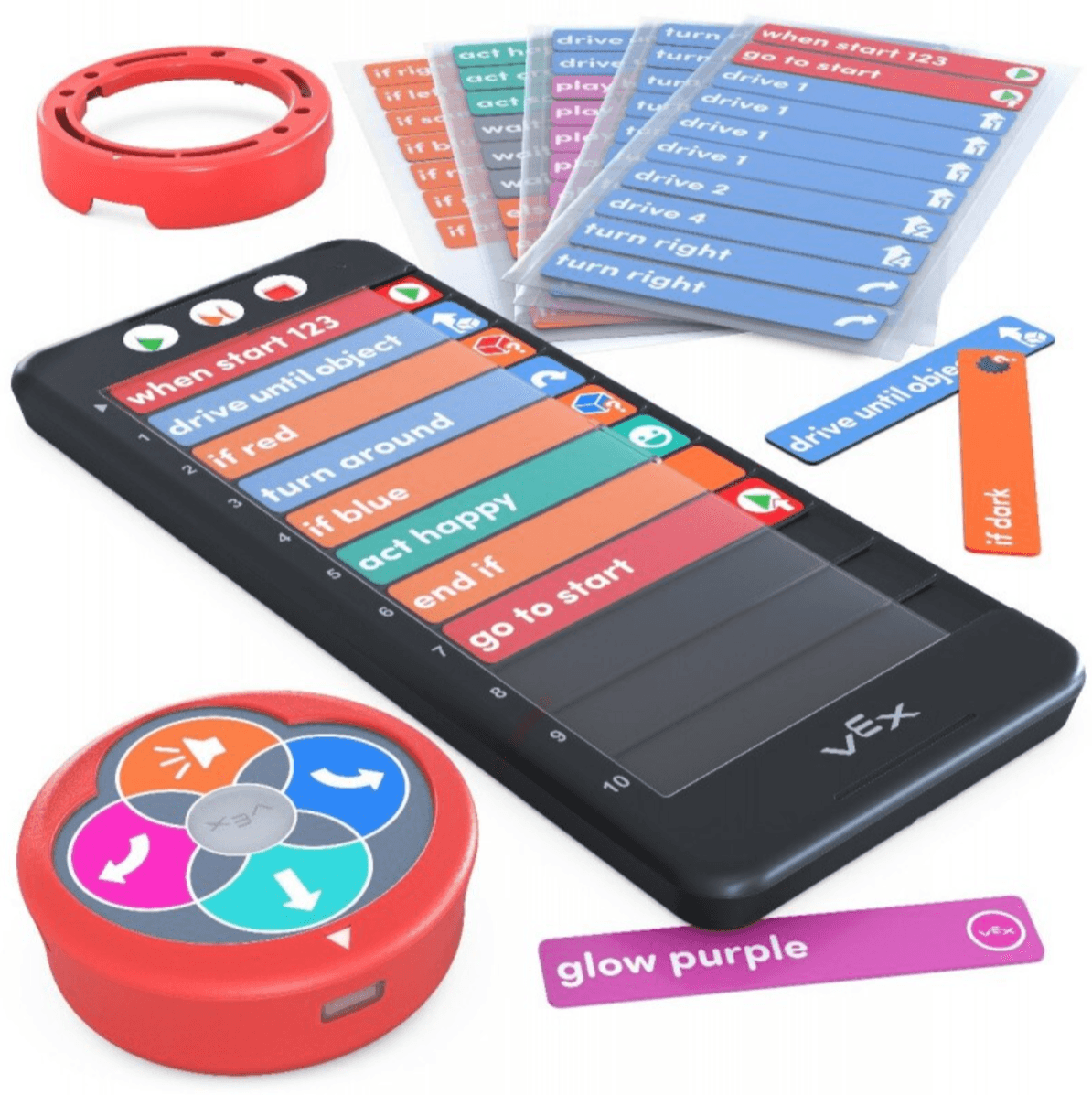
STEAM 123 is designed for younger students (G1–2) as an introduction to Science, Technology, Engineering, Arts, and Math. After the program, students will acquire basic scientific knowledge and foundational robot building skills. During the learning process, they will also be exposed to Arts, Math, and even language learning. STEAM 123 uses simple screen-free coding discs or the coding app, helping young learners build computational thinking, sequencing, and problem-solving skills.
By the end of the program, students should be able to:
Understand what robots are and how they follow instructions
Use sequencing and loops to program a robot
Use sensors to interact with the environment
Understand basic robot building skills
Develop an interest in scientific exploration
Collaborate and communicate effectively in teams
(Foundational STEAM Concepts – Teaching Target)
Students learn what a robot is and how it can sense, think, and act.
Key ideas:
What robots do in real life (cleaning, exploring, helping)
Robots follow commands and perform actions
Robots use inputs (sensors) and outputs (motors, lights, sounds)
Difference between humans and robots (decision-making vs. programming)
VEX 123 introduces the basics of coding logic through hands-on play.
Core programming concepts:
Sequence: understanding that robots follow instructions in order
Repetition (Loop): repeating actions to save time and effort
Events: starting programs with “when start” or button triggers
Conditional logic: simple decision-making (if…then)
Debugging: finding and fixing mistakes in command sequences
Programming tools:
V123 Coder + Coding Cards (physical coding)
Students control the 123 Robot to understand motion and spatial reasoning.
Key motion concepts:
Moving forward, backward, and turning (90° rotations)
Understanding distance and direction
Combining movements to create paths
Speed and timing awareness
123 robots have built-in sensors that help students explore how robots “sense” the world.
Key sensors:
Eye Sensor: detects color and light
Bumper Sensor: detects touch (pressed or released)
Sound Sensor: robot reacts to sounds (clap or tap)
Learning outcomes:
Understand cause and effect (e.g., if bumper pressed → stop moving)
Build logic through sensor-based actions
Use sensors to make decisions and interact with the environment
Students engage in simple scientific experiments to observe reactions.
Key process:
Observe
Hands On
Discussion
Multiple subjects:
Math: counting steps, directions, angles
Language Arts: storytelling with robot movements
Technology: motion, light, structure, and sound
Social-Emotional Learning: teamwork, communication, patience